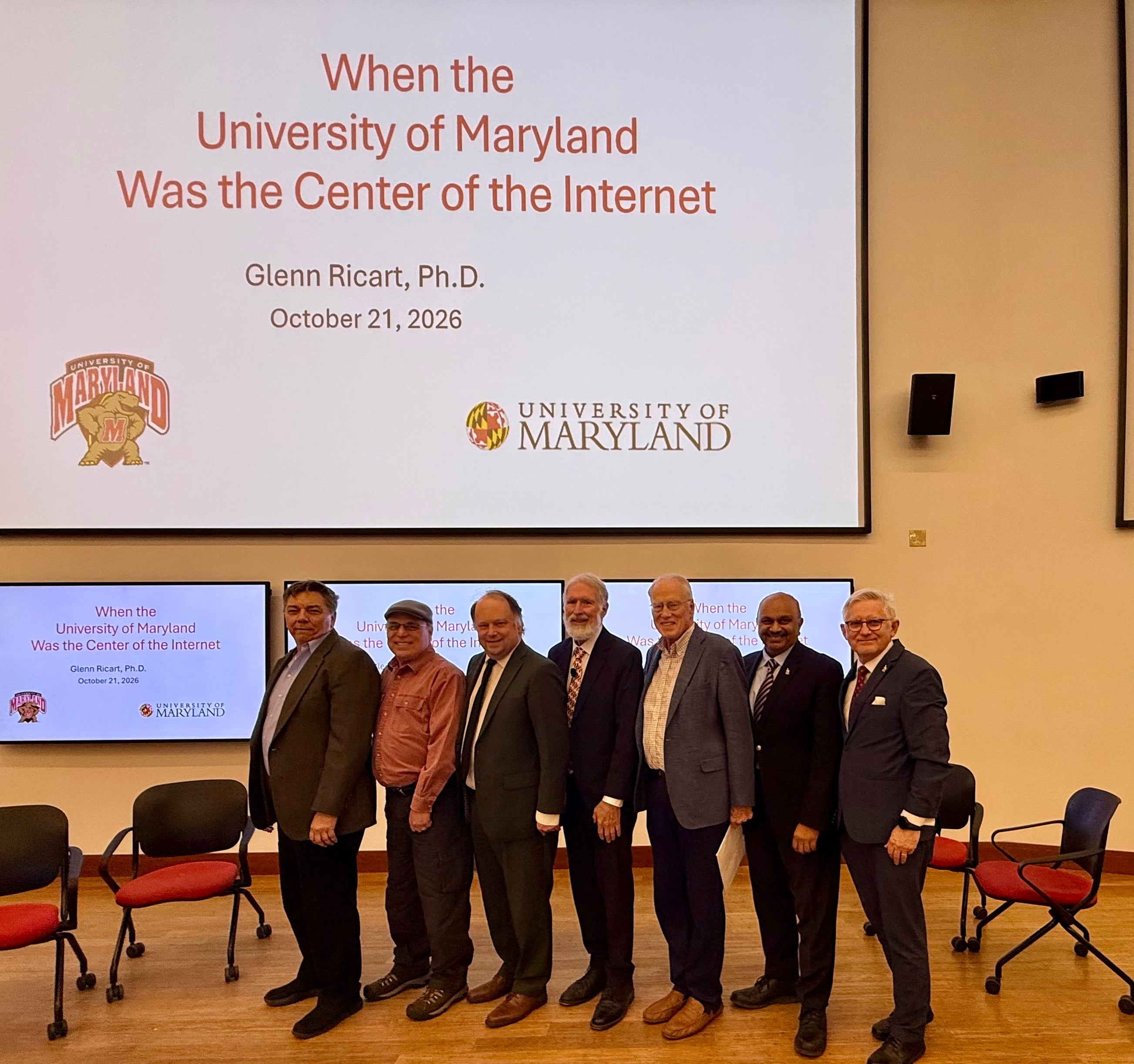
“Our university and our region have been the hub of technological discovery and progress for more than a century,” said President Pines, as he and Vice President Patrick O’Shea kicked off the “When UMD Was the Center of the Internet” event on October 21. He noted that UMD established its “place in history as the first university in the world to fully connect by internet protocols, and home to the first internet exchange point between commercial, government, and academic computer networks,” placing those achievements as a key local milestone between the first local and trans-Atlantic telegraph signals sent near College Park and the university’s current cutting-edge work on quantum computing and networking.
Dean of the College of Computer, Mathematical, and Natural Sciences Amitabh Varshney and Chancellor Emeritus William Kirwan also offered introductory remarks at the event co-hosted by the Division of Research, CMNS, and DIT.
Nearly 100 students, faculty, staff, and community members attended the event, during which Glenn Ricart, the university’s director of the Computer Science Center at the time, shared the history of the university’s involvement in the creation of the modern internet during its early days in the 1980s and 1990s.
He shared that in February 1982, “networking” at UMD relied on several vans that traveled around campus twice daily to pick up programming punch cards for testing. Consequently, researchers were limited to testing their code only once per day, as electronic transmission processes did not yet exist.
He recounted how, over the next several years, UMD community members seized the opportunity to use new TCP/IP software developed for ARPANET for academic and administrative purposes across campus. They built new hardware capable of connecting computers throughout UMD with each other and with the university’s ARPANET hardware. (ARPANET, the Advanced Research Projects Agency Network, was developed in the 1960s by the U.S. Department of Defense to create a resilient network that could withstand individual component failures. The first ARPANET message was sent in October 1969, and UMD hosted one piece of the original large and expensive equipment.) The UMD-developed hardware was smaller and more affordable, allowing other institutions seeking to connect to ARPANET to adopt it more easily.
He also explained how UMD became the first campus to connect all 125 of its buildings using fiber optic communication cables, creating a local network with the fastest connection speed available at the time (1 Gbps).
UMD community members also further developed the TCP/IP software needed to connect to ARPANET, and it was made available to other institutions. As a result, in addition to being connected internally, UMD established electronic connections with other universities.
Around this time, the Southeastern Universities Research Association (SURA) was established, with UMD as a founding member institution. SURA aimed to build a network, SURANet, to connect member institutions for communication, collaboration, and supercomputer sharing. In 1985, the National Science Foundation funded SURANet and announced five supercomputers outside SURA states that would be connected through the network. By 1987, 24 education and government research sites were connected via SURANet, and that number continued to expand. Based in College Park and managed by the University of Maryland, the network effectively made UMD the center of the internet.
Following Dr. Ricart’s presentation, Vice President and CIO Jeffrey Hollingsworth facilitated a panel discussion featuring Dr. Ricart alongside Louis Mamakos and Michael Petry, who were also at UMD in the early days of the internet helping develop TCP/IP software for IBM PCs while taking classes. They shared memories from that era, including wiring struck by lightning, student runners dispatched from the president’s office to announce snow days who were later replaced by networked printers, and the first internet malware attack in 1988. Dr. Ricart also recalled expanding SURANet to Brazil and other South American nations, and panelists discussed their subsequent work after leaving UMD before taking questions from the audience.
When asked how the younger generation can leverage their time at UMD to make an impact and change the world, they advised: Look for a place where you can make a difference. Bring ideas. Try things.